NTP [Network Time Protocol]
Unit 4, 2-8 South St
Rydalmere, NSW 2116
T: 13 14 91
F: 1800 659 025
W: www.simplextime.com.au
NTP definition & Application
Document: NTP.doc Issued: October 2008
16 servers. Generally speaking, every server syncronised with a stratum n server is termed as
being at stratum n+1 level. So, there are a few stratum 1 servers which are referenced by
stratum 2 servers, which in turn are referenced by stratum 3 servers, which are referenced by
stratum 4 and so on.
Q: What is a Network Hub?
A: A Network Hub is an intelligent device that simply connects all ports to allow
intercommunication. Hubs operate all ports at the same common speed. Not all hubs can
change network speed. If the hub can select a speed (10/100/1000MHz) it will choose a speed
that suites the slowest device connected.
Example: A network hub with 4 computers A/B/C/D. Computer A and B can communicate
together, and Computer C and D can communicate together but they need to share the
network lines. And effectively take turns, making the throughput of data less efficient and
create bottle necks. A good analogy is a 4 lane two way motorway that gets reduced down to
a 1 lane one way side street, things bottle up, and slow everything down.
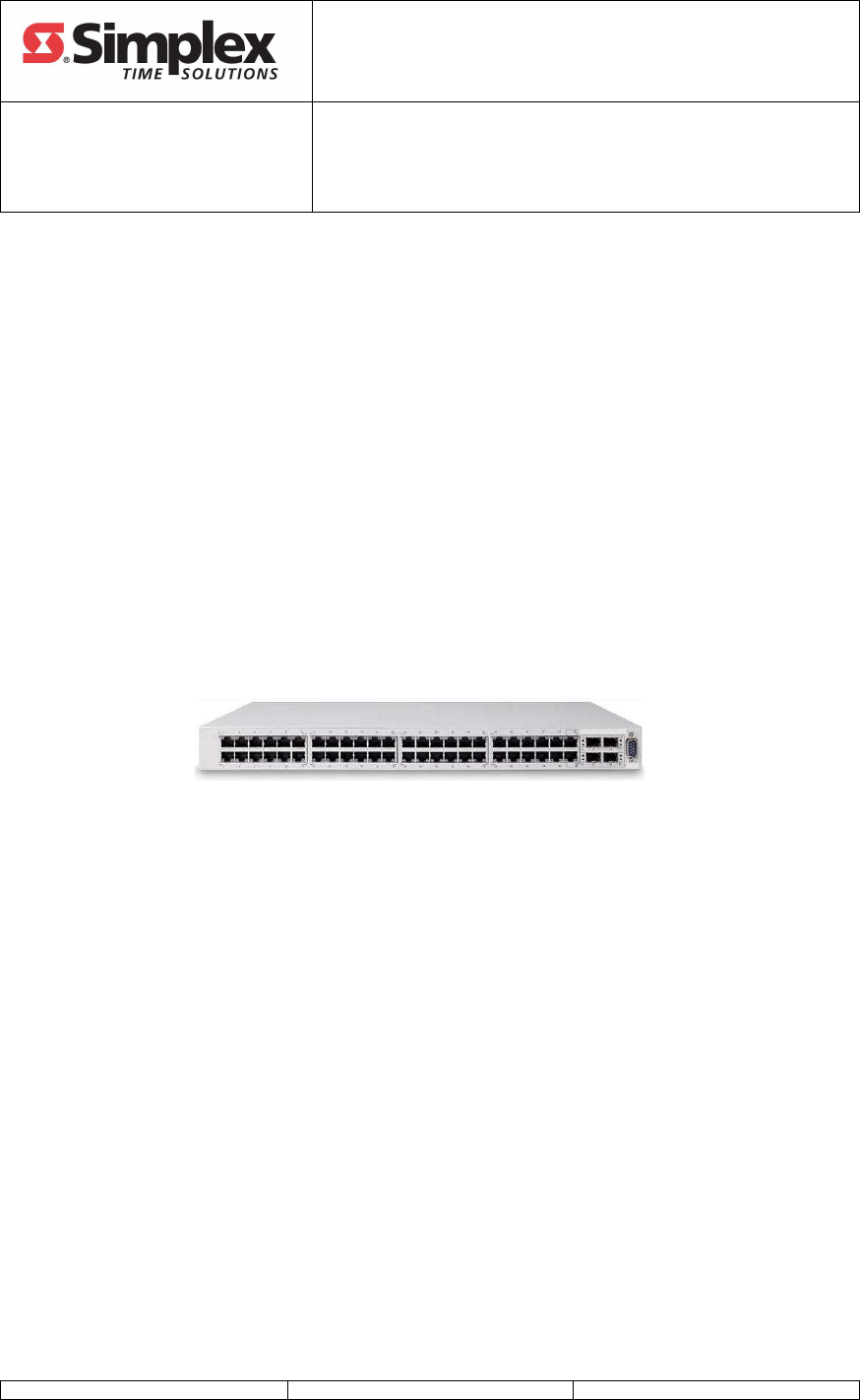
Q: What is a Network Switch?
A: A Network Switch or Network Bridge is an intelligent device allows intercommunication
between devices connected. It differs from a Network hub as it allows each port to set a speed
optimal for the connected device. As an example it is conceivable some devices will be
operating at 10MHz, 100MhZ, 1GHz and 10GHz.
The network switch will only pass essential data traffic down each port. The switch is like a
postman. A switch can therefore have several private data conversations happening at the
same time.
Example: A switch with 4 computers A/B/C/D. Computer A and B can communicate in
isolation. Computer C and D can communicate in isolation. A simple analogy is that each of
the 4 motorway lanes continues from source to destination without having share the lane with
anyone else.

 Manymanuals.com
 Manymanuals.de
 Manymanuals.fr
 Manymanuals.it
 Manymanuals.pl
 Manymanuals.cz
 Manymanuals.es
 Manymanuals-pt.com
Komentáře k této Příručce